
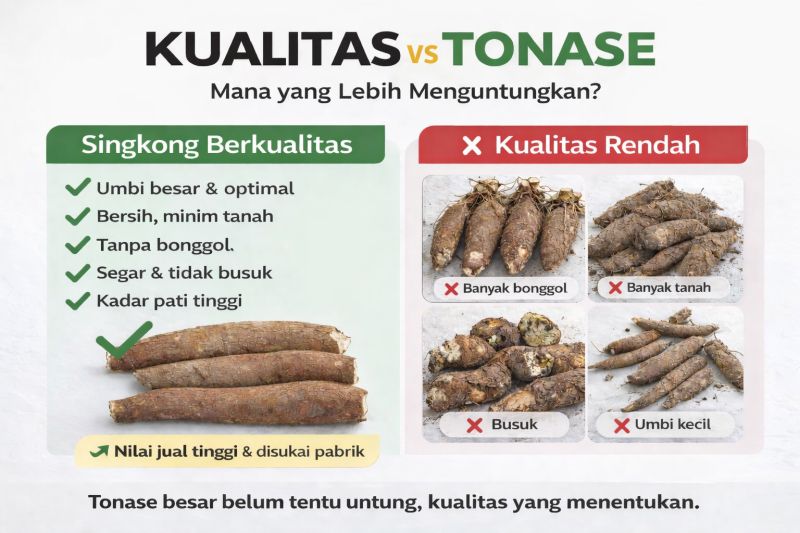
Cassava Quality Standards: A Strategy for Winning the Market
Farmers focus on volume, factories demand quality. Understanding cassava quality standards is not just about meeting requirements — it is a strategy for winning the market and securing premium prices.
In the cassava supply chain, there is a persistent gap in perspective: farmers focus on volume, while factories demand quality.
In reality, both must go hand in hand. Quality is not just a standard — quality is a strategy for winning the market.
What Makes High-Quality Cassava?
Here are the quality characteristics used as benchmarks by processing factories:
✅ Good Quality Indicators
- Large and uniform tubers: consistent size simplifies the processing workflow
- Fresh condition: harvested and delivered within 24 hours
- Minimal soil residue: tuber cleanliness directly affects dry matter content
- No long stems: tubers free from stalk remnants
- High starch content: ≥25% for the premium category
❌ Poor Quality Indicators
- Rotting or moldy tubers
- Excessive soil adhesion
- Undersized tubers (diameter < 3 cm)
- Low starch content due to improper fertilization
Why Does This Matter?
Tapioca factories purchase cassava based on starch content (DP/Dry Pati). Each additional percentage point in starch content can mean a significant price difference per kilogram. Farmers who understand these standards and apply the right cultivation practices will always have a stronger bargaining position.
KPMP Sahabat Tani Nusantara's Role
Through our partnership program, partner farmers receive:
- Technical assistance to increase cassava starch content
- Access to superior varieties with high starch potential
- Purchase guarantees at prices that reflect quality
Together, let's raise the standard of Indonesian cassava.
#Cassava #IndonesianAgriculture #Partnership #SupplyChain #Productivity